How much concrete do you need?
You need the volume of the space you plan to fill, plus a small allowance for waste and uneven conditions. This concrete calculator works with slabs, walls, footings, round columns, round tubes, and stairs. It returns cubic feet, cubic yards, and cubic meters, then estimates the number of pre-mix bags for common bag sizes.
The right unit depends on how you plan to order. Ready-mix suppliers often quote cubic yards or cubic meters, while a small repair may use 40 lb, 60 lb, or 80 lb bags. Enter dimensions in the units shown by the shape, and review the final unit before placing an order.
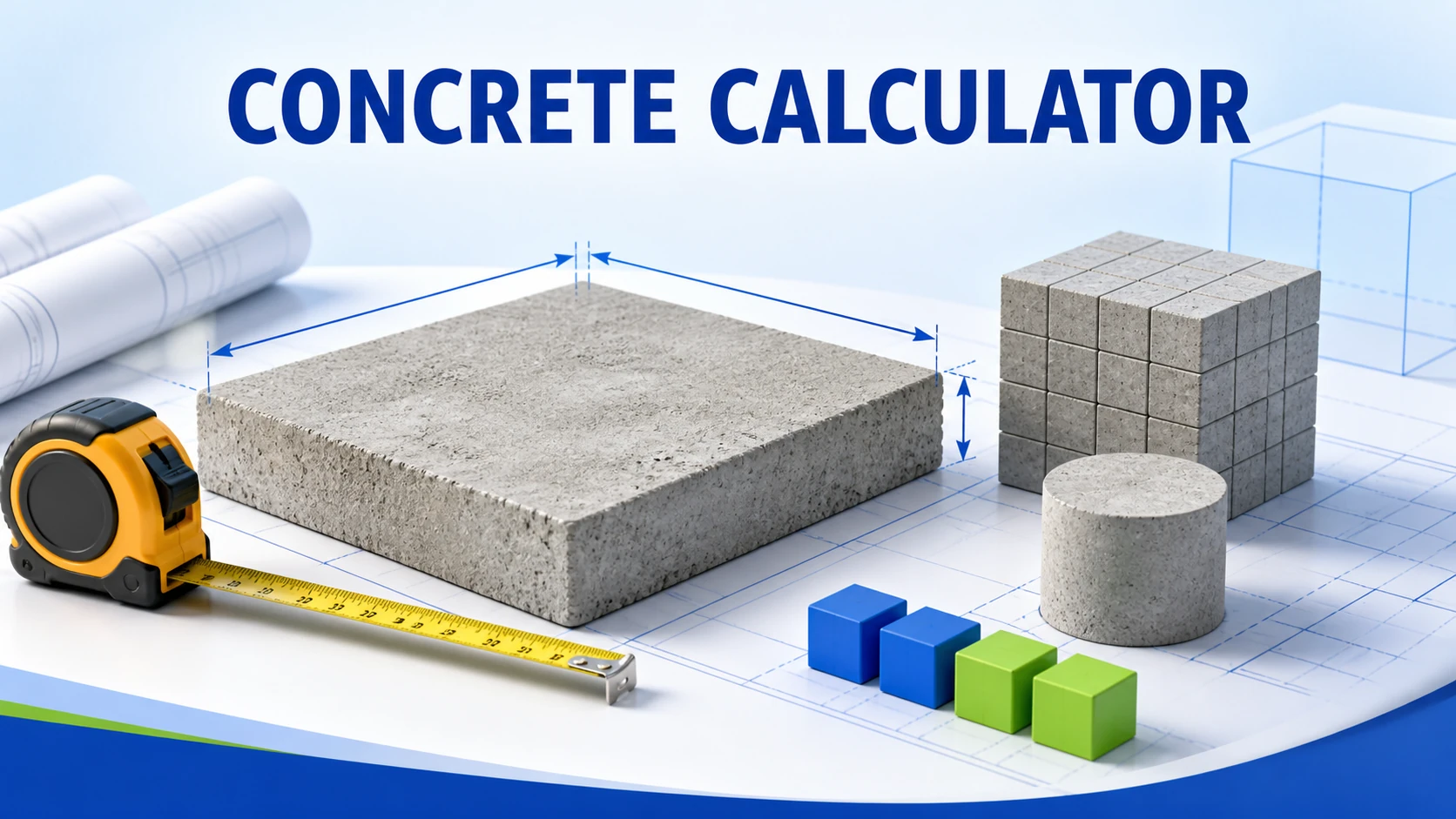
How do you use the concrete calculator?
The calculator first finds the volume of one shape. It then multiplies that volume by the number of repeated pieces and converts the result into common ordering units. Bag estimates use the yield values assigned to each bag size, so the label on the product you buy still deserves a final check.
- Choose a shape. Select the option that matches the form you’re filling.
- Enter dimensions. Add length, width, thickness, height, radius, or step sizes as shown.
- Set the quantity. Enter the number of identical slabs, columns, tubes, or steps.
- Read the estimate. Compare cubic volume and bag counts before adding the site allowance.
The formulas behind each shape
Each shape uses a standard volume formula. Keeping the formula visible makes it easier to spot a wrong dimension, especially when a footing is entered in inches and the result is ordered in yards.
- Slab, wall, or footing. Length × width × thickness gives the rectangular volume.
- Round column. Pi × radius² × height gives the cylinder volume.
- Round tube. The outside cylinder volume is reduced by the inside opening.
- Stairs. The calculator adds the volume of each step and the optional top platform.
A circular measurement needs a radius, not a diameter. If you measure across the full circle, divide that number by two before entering it. This small detail can double the result when it’s missed.
How many bags of concrete are in a cubic yard?
One cubic yard equals 27 cubic feet. Using common yield estimates, an 80 lb bag covers about 0.6 cubic feet, a 60 lb bag about 0.45 cubic feet, and a 40 lb bag about 0.3 cubic feet. That works out to roughly 45, 60, or 90 bags per cubic yard. Actual yield changes by product, so use the number printed on the bag when the order needs to be exact.
Bagged concrete suits small pours, repairs, posts, and short sections. A larger slab may be easier to order from a ready-mix supplier, especially when many bags would need to be mixed and placed before the concrete starts to set.
How much extra concrete should you order?
- Check the base. Dips, soft ground, and uneven forms can increase the real volume.
- Use a small allowance. Five to ten percent is a common planning range for simple pours.
- Round bags upward. Bagged concrete is sold in whole bags, not fractional quantities.
- Review access. A difficult delivery route may change the best ordering method.
Concrete work is sensitive to timing and placement. The calculator gives a quantity estimate, but it doesn’t check reinforcement, soil capacity, form strength, curing, or structural design. For load-bearing work, use the project drawings and advice from a qualified professional.
How can you avoid a wrong concrete estimate?
Measure the finished form rather than the rough sketch, and write every dimension in the same unit before you enter it. Check the thickness at several points when the ground is uneven, because one thin edge can hide a larger volume elsewhere. For steps, count the risers and treads carefully and include any landing that will be poured at the same time. These checks take a few minutes, but they are often more useful than adding a large unexplained buffer.
The final order should also match the way the material arrives. A ready-mix quote may use a different unit from a bagged product, so compare cubic volume first and bag count second. If the project is large, confirm the supplier’s minimum order, delivery timing, and product yield before you schedule the pour.
Frequently asked questions
How do you calculate how much concrete you need?
You work out the volume of the shape, then convert it to cubic yards or cubic meters, the units concrete is sold in. For a slab, multiply length by width by thickness. For a round column, use pi times the radius squared times the height. This calculator does the math for each shape and also estimates how many pre-mix bags you would need.
How many bags of concrete are in a cubic yard?
It depends on the bag size. A cubic yard is 27 cubic feet. An 80 lb bag yields about 0.6 cubic feet, so you need about 45 bags per cubic yard. A 60 lb bag yields about 0.45 cubic feet, which is about 60 bags per cubic yard. The calculator shows the bag count for 40, 60, and 80 lb bags.
Should I order extra concrete?
Yes. It is common to add about 5 to 10 percent extra to cover spillage, uneven subgrade, and waste. Running short in the middle of a pour is a real problem, so a small buffer is worth it. Add the extra to the volume this tool gives you before you place an order.
What units does the concrete calculator use?
You can enter each dimension in feet, inches, yards, meters, or centimeters, and mix units between fields if you like. The result is shown in cubic feet, cubic yards, and cubic meters, so it works whether you order in imperial or metric.
How do I calculate concrete for a round column?
Switch to the Column tab, enter the diameter and the height, and the tool uses the formula pi times the radius squared times the height. The radius is half the diameter. If you are pouring several identical columns, set the quantity and it multiplies the volume for you.
Is this concrete calculator accurate?
The volume math is exact for the shapes shown. Bag counts use the standard yields printed on common pre-mix bags, rounded up to whole bags. Real jobs vary because of waste and subgrade, so treat the bag count as a close estimate and add a small buffer before ordering.